
Your cart
There are no more items in your cart




Ear Puncher
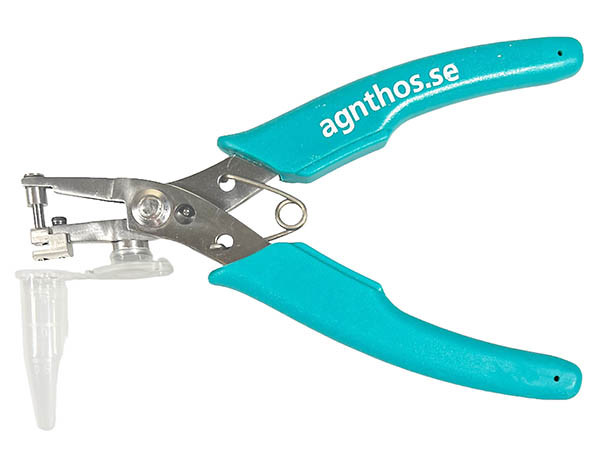
This stainless-steel ear punch tool is engineered for consistent, humane ear punching during ID marking and tissue collection.
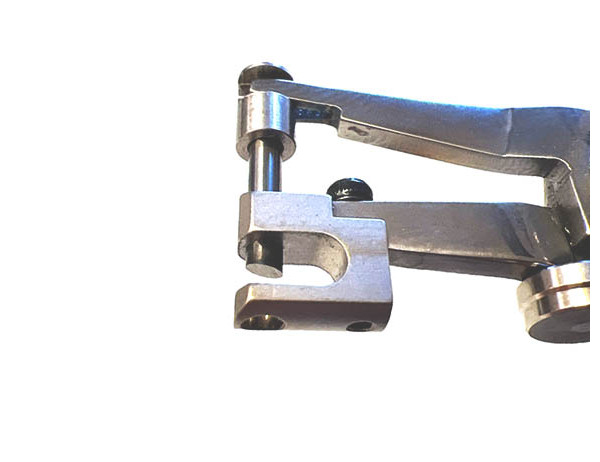
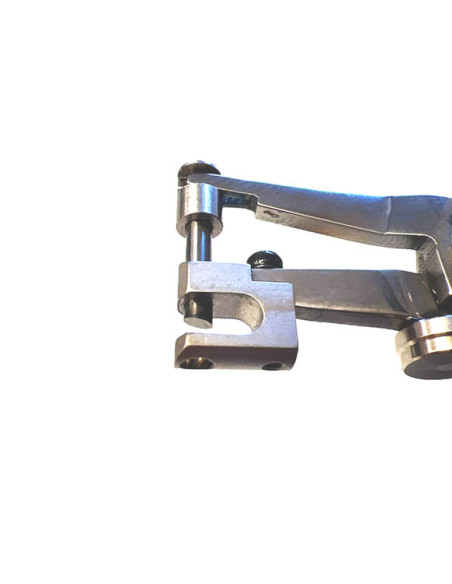
The sloped cutting edge cuts cleanly rather than crushing, requiring only gentle pressure—reducing wrist strain for staff and minimizing animal discomfort.
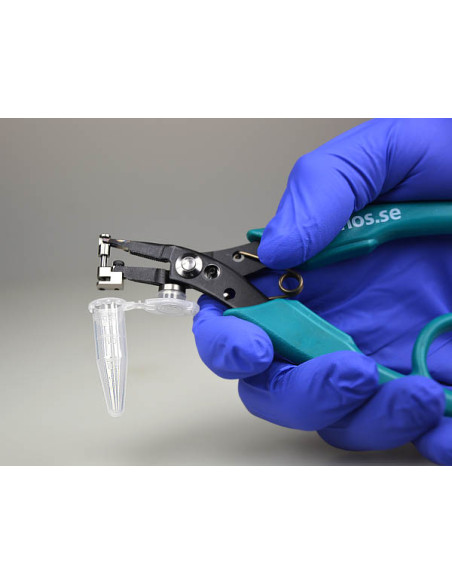
The latest design features an integrated Eppendorf-lid holder (“puck”) that securely aligns a 1.5 mL tube lid, allowing the biopsy to drop directly into the tube—clean, fast, and ready for downstream genotyping.
The punch is autoclavable; for long, trouble-free use, re-lubricate after sterilization according to your SOP.
| Art. no | Description | Price | ||
|---|---|---|---|---|
|
|
Ear punch pincer, hole 2mm OD Stainless Steel | Sign in | ||
|
|
Ear punch pincer, hole 2,75mm OD, Stainless Steel | Sign in | ||
|
|
Eppendorf Safe - Lock Tubes Colorless, 1.5 mL, 100pcs | Sign in | ||
|
|
Ear punch pincer, hole, 2,75mm Stainless Steel, for fish fins | Sign in | ||
- Low-force action; sloped edge for a clean cut
- Integrated holder for direct biopsy capture into 1.5 mL tubes (tubes also available in 100-packs)
- Durable stainless steel, autoclavable (re-lubricate after autoclaving)
- Variant AT7075-AQUA with larger opening for fish fin clipping
Accurate identification is fundamental to study integrity. Among common mouse identification methods in research - temporary marker on fur, tattoo, visual ear tags, ear punch, and microchip (RFID) - ear punching remains a proven approach for rodents because it can combine ID marking and genotyping in a single, well-controlled step. With this ear punch you get crisp, repeatable holes that correspond to standard notch/hole maps, while the integrated tube-lid holder streamlines sample capture and minimizes handling time at the rack.
The cutting geometry is the difference. Traditional punches can compress tissue before cutting; this tool’s sloped cutting edge shears cleanly, requiring less force and producing a more uniform hole. Technicians report less wrist fatigue across large cohorts, and supervisors appreciate the consistency that supports SOP compliance and audit trails. Because the instrument is autoclavable, it fits seamlessly into aseptic workflows - just remember to apply a suitable lubricant after sterilization to maintain smooth action.
Ear punch (this tool): Immediate, visible ID; enables simultaneous tissue collection for genotyping; low consumable cost; ideal for colony management and early life stages per facility guidelines. However, marks are visible and - depending on patterning - can be limited in number.
Microchip (RFID): Permanent, unique ID with automated scanning and minimal transcription error; excellent for long-term or regulated studies. Requires readers, implantation training, and higher per-animal cost; not typically used in very young neonates.
In practice, many facilities use both: ear punch for rapid colony work and genotyping, microchip for definitive, long-term identity in selected cohorts.
Tap to zoom
